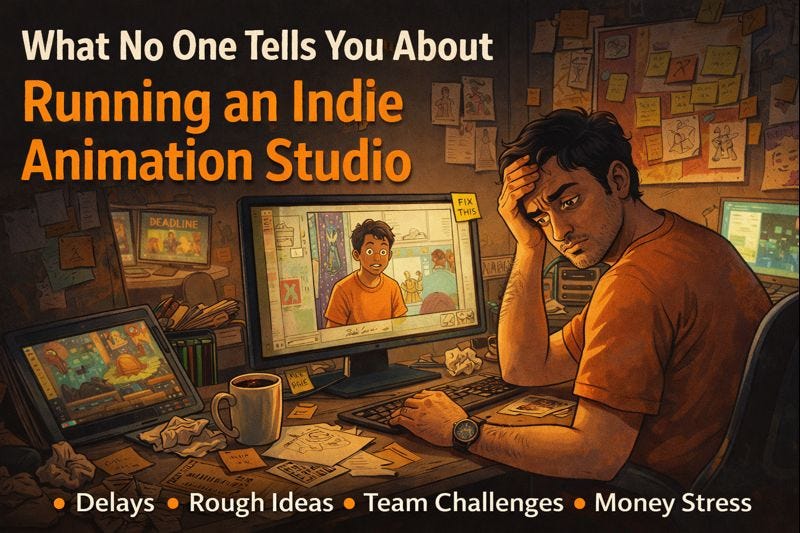
What No One Tells You About Running an Indie Animation Studio

When people hear “indie animation studio,” they imagine creative freedom.
Late nights drawing characters you love.
A tight-knit team.
Stories that don’t answer to anyone.
That part is real.
But there’s a lot no one tells you about what it actually takes to keep an indie animation studio alive especially in India, especially without big funding, and especially when you’re trying to build original IP instead of service work.
This isn’t a motivational post.
This is the reality.
1. Everything Takes Longer Than You Think (Yes, Everything)
Animation is slow by nature.
Indie animation is slower.
No matter how optimistic your timeline is, it will slip.
A 2-week task becomes a month
A “small tweak” becomes a full rework
A character you loved stops working halfway through production
And delays don’t always come from laziness or lack of skill. They come from:
Iteration (which is unavoidable)
Limited manpower
People juggling multiple responsibilities
Real life interfering with creative work
The hardest part isn’t the delay itself—it’s managing morale when things slow down.
You constantly ask yourself:
“Are we behind because we’re failing… or because this is just how animation works?”
Most of the time, it’s the second.
2. Ideas Are Cheap. Finishing Is Brutal.
Everyone has ideas.
You’ll be drowning in them:
New characters
New shows
Spin-offs
Short-form concepts
“What if we just tried this once?”
The real challenge isn’t coming up with ideas—it’s deciding what NOT to make.
Every new idea competes for:
Time
Energy
Attention
Money
In an indie studio, chasing too many ideas is the fastest way to kill all of them.
One of the most painful skills you learn is this:
Killing good ideas so one great idea can survive.
And no one prepares you for how emotionally hard that is.
3. Team Management Is Not About Control ,It’s About Clarity
Most indie studios don’t fail because the team isn’t talented.
They fail because expectations are unclear.
Common problems:
People don’t know why something matters
Feedback comes too late
Roles blur too much
Everyone is “doing everything,” which sounds noble but burns people out
Creative people don’t need micromanagement.
They need context.
Why this scene matters.
Why this deadline exists.
Why this character can’t change again.
When clarity is missing, frustration fills the gap.
And as a studio lead, you learn quickly:
If the team is confused, it’s probably a leadership problem—not a talent problem.
4. Motivation Is Not Constant (And That’s Normal)
No one tells you this, but passion fluctuates.
There are days when:
The work feels pointless
Progress feels invisible
Views don’t match effort
Silence from the audience feels louder than criticism
In indie animation, external validation comes late sometimes very late.
So you learn to run the studio on something stronger than motivation:
Discipline
Routine
Belief in the long-term vision
You don’t wait to “feel inspired.”
You show up anyway.
5. Money Shapes Creative Decisions More Than You Admit
Even when you say “we’re doing this for the art,” money is always in the room.
It affects:
How big a story you can tell
How polished something can be
How long you can afford to experiment
How patient you’re allowed to be
Indie doesn’t mean “money doesn’t matter.”
It means every rupee matters more.
This is why transparency within the team and with collaborators is crucial. Pretending money isn’t a constraint only creates resentment later.
6. You’re Not Just Building Content. You’re Building Culture.
The hardest truth?
You’re not just making animations.
You’re building:
A work culture
A creative philosophy
A standard for how stories are treated
A reputation that will outlive any single project
This takes time.
It’s invisible work.
And it doesn’t trend on social media.
But this is what makes an indie studio real.
7. Why Do It Anyway?
With all the delays, doubts, compromises, and exhaustion—why do it?
Because when something finally works…
When a character connects…
When someone sees themselves in your story…
There’s nothing like it.
Indie animation isn’t easy.
It isn’t fast.
It isn’t glamorous.
But it’s honest.
And in a landscape full of shortcuts, that still matters.
If you’re running or thinking of running an indie animation studio: you’re not behind.
You’re just early.
And that’s okay.